
What is MIPS?
MIPS or Merit-Based Incentive Payment System is a quality payment incentive program which rewards value and outcome based on provider or practice performance score. Incentives are paid out as positive adjustments to your Medicare reimbursements.
- Financial Benefits: avoid -9% penalty and possible earn up to +9% bonus in Medicare reimbursement
- Reputational Impact: Scores are published on CMS Physician Compare.
What is the MIPS score?
The MIPS score is a clinician’s final score in MIPS. It’s made up of four MIPS category scores. Each category is first scored separately. Then, MIPS scoring combines those category scores into one final score with some categories being worth more than others. The combined score is your MIPS composite score, ranging from 0-100.
How is the provider scored for MIPS?
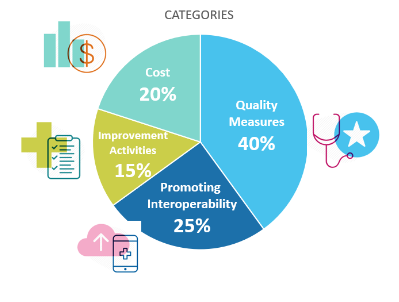
There are 4 Performance Categories that make up the score.
- Quality
- Assesses the quality of care delivered based on measures of performance.
- Providers choose and submit 6 measures in this category. This is the highest weighted, at 40%, and is collected over the course of the entire year.
- Measures tracked by WRS can be viewed in Administration > EMR Setup > MIPS/MU Quality Measures.
- Promoting Interoperability
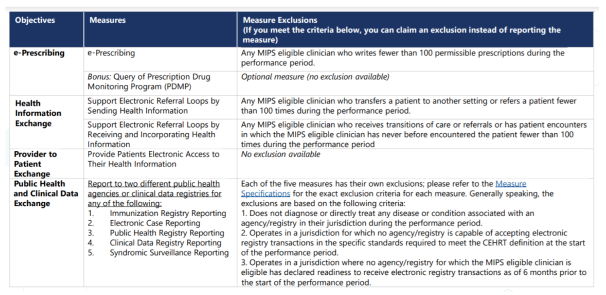
- Focuses on the electronic exchange of health information using certified electronic health information record technology (CEHRT) between provider to patient (and vice versa) and provider to provider . It is the next highest weighted at 25%, with a reporting period of 90 consecutive days.
- WRS captures and reports data for ePrescribing, Provide Patient Access, Send Summary of Care, and Request/Accept Summary of Care.
- Improvement Activities
-
Assesses participation in clinical activities that support improvement in patient engagement, care coordination, and patient safety. Providers can submit up to 4 activities that are performed over the course of 90 consecutive days. It is weighted at 15% is one of the easiest categories to meet top performance. Providers can choose to report between the following: 2 high-weighted activities OR 1 high-weighted activity and 2 medium-weighted activities, OR 4 medium-weighted activities.
*WRS does not collect data for this category.
-
- Cost
-
Assesses the cost of the care provides based on your Medicare claims and is automatically calculated by Medicare.
*WRS does not collect and submit data for this category.
-
What is a good MIPS score for 2021?
MIPS 2021 Score Threshold is 60 points. To avoid a -9% penalty, you must score at least 60 points. To be eligible for bonus money you must score at least 85 points (Exceptional Performance Bonus).
What is the MIPS penalty for 2021?
The max penalty for the 2021 reporting year is 9%.
How do I know if I'm eligible?
Use the CMS NPI lookup tool to help you determine your eligibility.
An eligible clinician needs to meet the Low-Volume Threshold requirements in order to attest for MIPS:
- Bill more than $90,000 for Part B covered professional services AND
- See more than 200 Part B patients AND
- Provide 200 or more covered professional services
What clinician types are eligible for MIPS?
- Physicians
- Physician Assistants
- Nurse Practitioners
- Clinical Nurse Specialists
- Certified Registered Nurse Anesthetists
- Physical Therapists
- Occupational Therapists
- Qualified Speech-language Pathologists, Qualified Audiologists
- Clinical Psychologists
- Registered Dietitians Or Nutrition Professionals
What happens if I choose not to report any data to MIPS?
If you are eligible and do not qualify for an exemption from MIPS in 2021, you will receive a -9% payment adjustment to your Medicare Part B fee-for-service (FFS) claims in 2023 if you do not report any data to MIPS.
What Is Individual Reporting and How Will It Impact My MIPS Score?
Each MIPS-eligible clinician, identified by a unique TIN/NPI combination, must individually report data for the Quality, Promoting Interoperability (PI), and Improvement Activities categories.
CMS will score the individual physician’s performance for 2021 and adjust his or her Medicare payments accordingly for 2023.
What Is Group Reporting and How Will It Impact My MIPS Score?
2 or more clinicians billing under the same Tax Identification Number (TIN) can report as a group. All eligible patient encounters for every physician in the group are aggregated together as a total population for the Quality and PI categories (i.e., measure denominators), and each physician’s performance in the group is aggregated (i.e., measure numerators).
If you elect to report as a group, every clinician billing under that TIN must report together. Clinicians who participate as a group will be assessed at a group level across all 4 MIPS performance categories and will receive one payment adjustment for the group’s performance.
Group reporting may be advantageous for some practices and probably not so advantageous for others. The best option needs to be determined on a case-to-case basis. Imay reduce the administrative burden and make meeting the requirements easier and is probably a good idea for clinicians who all score very similar numbers in the MIPS categories.
Is MIPS just for Medicare patients?
MIPS reporting of individual measures applies to all patients. Eligibility for a measure is based on CMS documentation (denominator criteria).
Are there exemption for eligible providers:
There are two exception applications available to clinicians in PY 2021:
The Extreme and Uncontrollable Circumstances Exception application allows you to request reweighting for any or all performance categories if you encounter an extreme and uncontrollable circumstance or public health emergency, such as COVID-19, that is outside of your control.
The MIPS Promoting Interoperability Performance Category Hardship Exception application allows you to request reweighting specifically for the Promoting Interoperability performance category if you qualify for one of the reasons identified below:
- You’re a small practice
- You have decertified EHR technology
- You have insufficient Internet connectivity
- You face extreme and uncontrollable circumstances such as disaster, practice closure, severe financial distress or vendor issues
- You lack control over the availability of CEHRT